

https://fabiociardi.blogspot.com/
The long awaited book “Paradiso ’49″ was launched at the Lateran University on Friday 22nd May. It was an event of great significance, with presentations of profound content. There will certainly be further updates…
The presentation took place in the Paul VI Hall. Those present included Judy Povilus. We recalled how, in that very same hall (which at the time was not yet called Paul VI Hall), in 1974–1975, we attended together the courses on Gaudium et spes given by Boniface Honings, the Dutch Carmelite…
At that time we could never have imagined that 50 years later we would find ourselves here again, united around nothing less than Paradiso ’49!
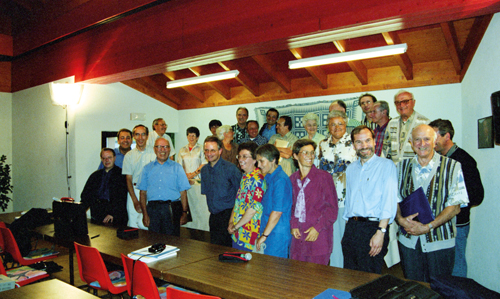 On 18 August 1998, in St-Maurice, Switzerland, I spoke about my experience in the Abba School, in which I had begun participating more than three years earlier, on 6 February 1995. Among other things, on that occasion I said, referring to the style of writing of the Paradiso:
“The first thing that struck me as soon as I arrived at the Abba School was the aesthetic dimension of Chiara’s writings. Paradiso is written in a modern language. It is beautiful. There is nothing superfluous. It is poetry of the highest order. It answers Garrigou-Lagrange’s expectation: ‘The great mystics, if they are to make their experience known to us, should also be great poets.’ Even from the form of her writing one immediately understands that God is Beauty, that Paradise is Beauty.
Photo of the Abba School in 2000, Città Nuova
Language takes on a particular importance in mystical writings. It has been said that the theologian always writes in prose, whereas the mystic writes in poetry even when writing prose. Chiara affirms and denies at the same time because she moves between the apophatic and the cataphatic; she makes use of paradox because her experience is paradoxical; of oxymoron because it is a human-divine experience; she creates new words and bends ancient words to new meanings, because her experience is new. Her language, to use again the words of Garrigou-Lagrange, approaches ‘the manner of speaking of the Lord in Scripture.’
A comparative study between ‘the language of the mystics’ and that of Chiara would be extremely interesting and would reveal many surprises. The communal dimension of her experience — the Soul — reveals itself in the language itself, and not only through the use of plurals, something new in mysticism, but also through the absence of reticence, so frequent among mystics, through the absence of obscurity, and through the simplicity of expression.”